
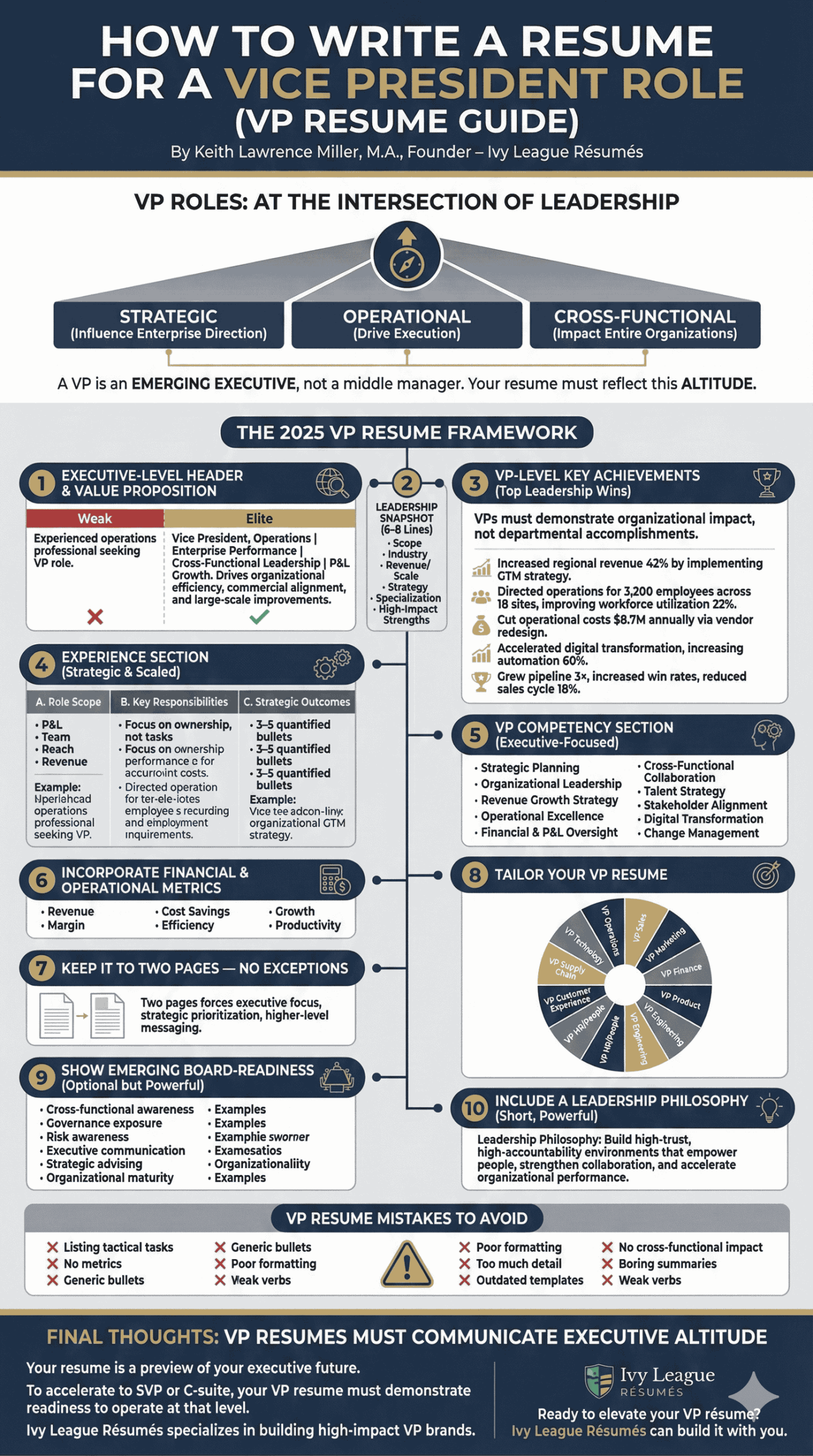
By Keith Lawrence Miller, M.A., Founder – Ivy League Résumés
Vice President roles sit at a unique intersection of leadership:
strategic enough to influence enterprise direction, operational enough to drive execution, and cross-functional enough to impact entire organizations.
A VP is not a middle manager — it is an emerging executive.
And your VP resume must reflect that.
In today’s competitive hiring market, your résumé must instantly communicate executive altitude, commercial intelligence, and cross-functional leadership. Recruiters, CHROs, and hiring teams want evidence of scale, impact, and strategic ownership — not mid-level tasks.
This guide breaks down exactly how to build a VP resume that positions you as an enterprise-level leader ready for the next step: SVP, EVP, or C-suite.
Why Vice President Résumés Are Different
VP-level candidates face a problem:
Most write résumés like accomplished managers.
But organizations want vice presidents who operate like emerging executives.
A VP résumé must communicate:
-
Strategic ownership
-
Enterprise-wide impact
-
Cross-functional leadership
-
Financial awareness
-
Team development
-
Scaled execution
-
Change leadership
If your resume reads like “projects and tasks,” you will be evaluated as a manager — not an executive.
The 2025 VP Resume Framework
An elite VP resume follows a specific structure designed for clarity, altitude, and impact.
Below is the same architecture I use for senior leaders in Fortune 500 companies, private equity portfolio companies, and high-growth environments.
1. Executive-Level Header & Value Proposition
Your opening must set the tone with:
-
Leadership identity
-
Strategic scope
-
Core strengths
-
Enterprise value focus
Weak example:
“Experienced operations professional seeking VP role.”
Elite example:
Vice President, Operations | Enterprise Performance | Cross-Functional Leadership | P&L Growth
Drives organizational efficiency, commercial alignment, and large-scale operational improvements across multi-site or national environments.
This positions you as a senior leader — not a job seeker.
2. Leadership Snapshot (6–8 Lines of Executive-Relevant Value)
This should highlight:
-
Scope of leadership
-
Industry context
-
Revenue/organizational scale
-
Strategic direction
-
Specialization (operations, sales, finance, product, technology, marketing, etc.)
-
High-impact strengths
This section establishes credibility instantly.
3. VP-Level Key Achievements (Your Top Leadership Wins)
This is one of the most critical differences between VP and mid-level résumés:
VPs must demonstrate organizational impact, not departmental accomplishments.
Examples of vice president resume examples that stand out:
-
Increased regional revenue 42% by implementing new GTM strategy and optimizing sales enablement infrastructure.
-
Directed operations for 3,200 employees across 18 sites, improving workforce utilization by 22%.
-
Cut operational costs by $8.7M annually by redesigning vendor strategy and centralizing key processes.
-
Accelerated enterprise-wide digital transformation, increasing automation by 60% and cutting cycle time across core workflows.
-
Grew pipeline 3× while increasing win rates and reducing sales cycle length by 18%.
VPs are evaluated on impact, not activity.
4. Experience Section (Strategic, Sharpened, and Scaled)
For each VP role, include:
A. Role Scope
-
P&L size
-
Team size
-
Geographic reach
-
Business unit responsibility
-
Revenue impact
B. Key Responsibilities (High-Level Only)
This should focus on what you owned, not what you “did.”
C. Strategic Outcomes
3–5 bullets maximum — each quantified and tied to business results.
Example:
-
Directed $500M business unit across 7 regions, improving profitability and workforce productivity.
-
Implemented Lean operations across 12 sites, lifting throughput by 36%.
-
Led GTM restructuring that increased revenue per rep by 14%.
5. VP Competency Section (Executive-Focused)
VP skills must reflect executive competencies, not technical skills.
Strong examples:
-
Strategic Planning
-
Organizational Leadership
-
Revenue Growth Strategy
-
Operational Excellence
-
Financial & P&L Oversight
-
Cross-Functional Collaboration
-
Talent Strategy & Team Development
-
Stakeholder Alignment
-
Digital Transformation
-
Change Management
This signals emerging executive maturity.
6. Incorporate Financial & Operational Metrics
Even non-finance VPs must showcase:
-
Revenue impact
-
Margin impact
-
Cost savings
-
Efficiency gains
-
Growth figures
-
Productivity improvements
Quantified accomplishments give your résumé commercial credibility — the #1 factor executives are judged on.
7. Keep It to Two Pages — No Exceptions
VPs occasionally make the mistake of expanding to three pages.
Three pages signals:
-
Lack of clarity
-
Weak communication
-
Manager-level thinking
Two pages forces:
-
Executive focus
-
Strategic prioritization
-
Higher-level messaging
The best VP resumes use whitespace and precise framing — not volume.
8. Tailor Your VP Resume to the Type of Vice President Role
Not all VP roles are the same.
Tailor your résumé to the strategic expectations of roles like:
-
VP of Operations
-
VP of Sales
-
VP of Marketing
-
VP of Finance
-
VP of Product
-
VP of Engineering
-
VP of HR / People
-
VP of Customer Experience
-
VP of Supply Chain
-
VP of Strategy
-
VP of Technology
Each of these roles requires different metrics, different capabilities, and different executive signals.
9. Show Emerging Board-Readiness (Optional but Powerful)
VPs who want to grow into SVP, EVP, COO, CFO, or CEO must show:
-
Cross-functional awareness
-
Governance exposure
-
Risk awareness
-
Executive communication
-
Strategic advising
-
Organizational maturity
Even subtle signals of board thinking elevate perceived seniority.
Examples:
-
Participated in executive steering committees
-
Led cross-functional transformation initiatives
-
Managed enterprise-wide governance projects
-
Supported CEO, CFO, or CHRO on strategic planning cycles
These differentiators accelerate VP-to-executive leap.
10. Include a Leadership Philosophy (Short, Powerful)
A 2–3 line statement showing executive maturity can differentiate your VP resume instantly.
Example:
Leadership Philosophy: Build high-trust, high-accountability environments that empower people, strengthen collaboration, and accelerate organizational performance.
Recruiters love leaders with a clearly articulated philosophy.
VP Resume Mistakes to Avoid
Common errors that immediately weaken VP candidacy:
❌ Listing tactical tasks
❌ No metrics
❌ Generic bullet points
❌ Poor formatting
❌ Too much operational detail
❌ Outdated templates
❌ No cross-functional impact
❌ Boring, corporate-speak summaries
❌ Weak verbs (managed, coordinated)
Avoid these, and your VP resume will stand out quickly.
Final Thoughts: VP Resumes Must Communicate Executive Altitude
The Vice President level is where leaders prove they can:
-
Think strategically
-
Communicate clearly
-
Execute at scale
-
Influence cross-functional direction
-
Drive measurable business outcomes
Your résumé is not just a record of your past — it’s a preview of your executive future.
If you want to accelerate to SVP or C-suite, your VP résumé must demonstrate the readiness to operate at that level.
Ivy League Résumés specializes in building these high-impact, enterprise-focused VP brands.
If you’re ready to elevate your VP résumé to executive and board-caliber standards, Ivy League Résumés can build it with you.
